
Royalty goes to new levels when Mardi Gras season hits. We have Mardi Gras Kings, Queens, Princesses and Duchesses crowned in festivals across the former Confederate States annually, as well as the grand Carnival celebrations in Europe and Latin America. Today is “Fat Tuesday”, the eve of the Mardi Gras, and the beginning of Lent in the Church calendar. How do all of these labels coincide? Here is a list of definitions:
Lent is the Christian season of preparation prior to Easter Sunday. The 40 day preparation includes reflection, repentance, fasting, and discipline for the purpose of identifying with, giving thanks for, and submitting to the sacrifice of Jesus Christ as our Savior.
Ash Wednesday marks the beginning of Lent. Many “give up” eating certain comfort foods, or doing certain “extravagant” activities in order to penitentially identify with Christ and His sacrifice.
Fat Tuesday is the last day (day before Ash Wednesday) to live it up before giving up your creature comforts!
Mardi Gras is the French literal translation for Fat Tuesday.
Shrove Tuesday is also another term for Fat Tuesday or Mardi Gras. Shrove is past tense for Shrive, meaning to hear confession, assign penance, and absolve from sin. In other words, Shrove Tuesday reminds the Christian that he or she is entering a season of repentance.
Pancake Day is ALSO the same meaning for infamous Tuesday in question! The contents of pancakes (fat, butter and eggs) were all forbidden foods during Lent. Great Britain marks Mardi Gras with big plates of pancakes instead of parades and society balls. But, they are the model for Royalty after all!
Carnival is Latin for “farewell to the flesh”.
Now that we have our definitions in place, let’s explore a few of the celebrations on this Fat Tuesday!
Mardi Gras in New Orleans was a rolling celebration by the 1730’s, with eight elegant society balls established by the then Governor to mark the season. It was decades later when the colorful parades began in the streets of New Orleans. Mobile, Alabama hosted the first Mardi Gras in America in 1703.

2014 Carnival Court, Rex Organization
rexorganization.com

2014 King and Queen of Carnival
rexorganization.com
Mardi Gras in Galveston began prior to the Lenten season 1867, just two years after the Civil War. Young ladies from across the South were invited to be apart of the “royal court” in celebration of the King and Queen of Frivolity for the Krewe, the Knights of Momus. World War II brought a halt to celebrations across our nation, and even the end of the war could not successfully revive the merriment of Galveston Mardi Gras. An attempt to bring back the regal Coronations of King Frivolous occurred in the late 1940’s, but the practice would sleep for a few more decades. In the early 1980’s a small group of men revived the Knights of Momus, and society’s daughters were once again invited be presented in a royal court wearing gowns fit for a queen. In fact, John Spencer, one of the men who brought life back to the Knights of Momus, arranged for Queen Elizabeth II’s (yes, the real Queen) dress maker to create the elaborate gowns for the first court of the new Galveston Mardi Gras era in 1984 at the historic Galveston Opera House.
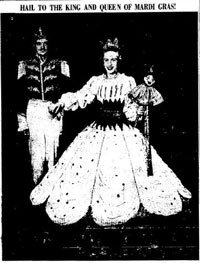
King Frivolous XXV, Mr. Harry Black, and his Queen, Miss Margie Beth Spiller, 1949
http://rosenberg-library-museum.org

Gown for Margie Beth Spiller, the “Queen of Galveston’s last Mardi Gras” in 1949
http://rosenberg-library-museum.org

2012 King and Queen for the Knights of Momus
http://www.houston.culturemap.com

2012 Duchesses in the Knights of Momus Coronation Court
houston.culturemap.com
Across Europe, throughout the Southern United States, and permeating Latin America, Mardi Gras/Fat Tuesday/Carnival will be celebrated in elaborate, frivolous style tonight, while Great Britain will celebrate with pancakes. How will you mark the beginning of the Christian season of Lent? More importantly, how will you mark the next 40 days in preparation for observing Easter?
 livingroyallytoday
hi!,I really like your writing very so much! share we keep in touch more
about your post on AOL? I need an expert on this space to
resolve my problem. May be that is you! Looking
ahead to peer you.